Point of Interest 2 of the Rawdon Lake Aquatic Tour
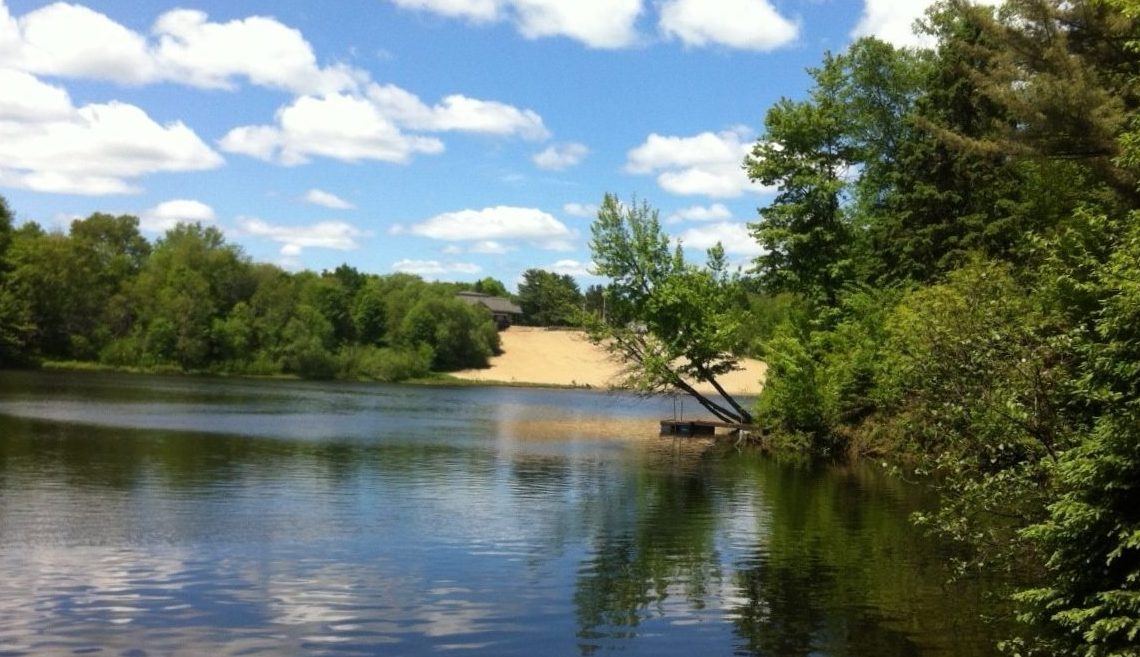
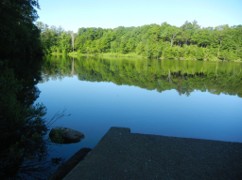
View of the shores of the lake near the municipal beach. Photo from the Société d’histoire de Rawdon
As part of this tour, the “resort area” refers to sector number 2 located past the municipal beach, stretching along both sides of the lake toward the dam bridge.
The lake, a major attraction in Rawdon
In the early 20_ century, Rawdon saw the emergence of a new phenomenon: vacationing. Bucking the trend of rural exodus, many city dwellers sought to leave the major urban centres to spend a season in country cottages (1).
Thanks to its favourable location—far enough from the cities yet still accessible—and the beauty of its lake, Rawdon quickly established itself as a sought-after vacation destination.
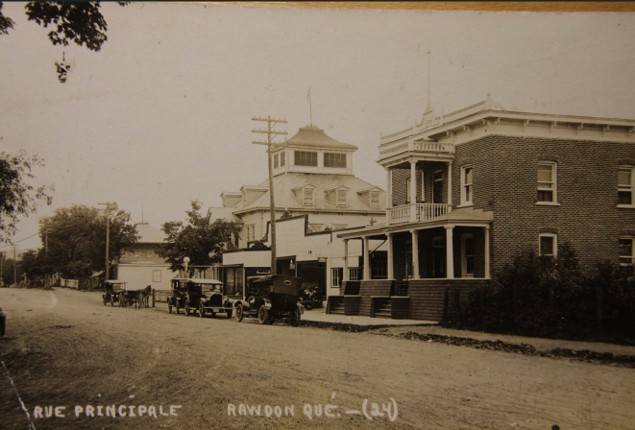
Postcard, Rue Principale – Rawdon, Que., source: BAnQ
View of Queen Street across from the town hall; the area offered a variety of services and accommodations for vacationers.
A renowned destination
By 1935, Rawdon’s reputation had already spread far beyond the region: in July, an article in the newspaper La Patrie celebrated the beauty of the falls, described as one of the most magnificent natural sights in Quebec and invited readers to discover this natural “theatre.” Establishments such as the Balmoral, renowned for its cuisine, and the Manoir Rawdon, popular for its dance floor, played a key role in the growth of the local resort industry (2).
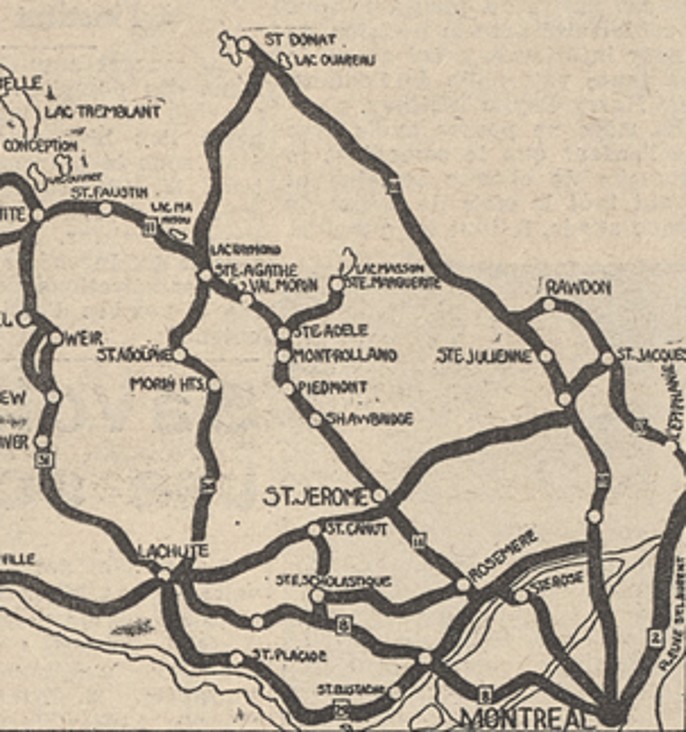
This article shows the location of Rawdon in the Laurentides, published in an article in La Patrie, July 4, 1935, pp. 18–19.
During this period, Rawdon was commonly associated with the Laurentians. The administrative regions of the Laurentians and Lanaudière, to which Quebec’s current territorial organization refers, were not established until 1987. Previously, the term “Laurentians” referred more broadly to the Laurentian Mountains, which extend north of the St. Lawrence River (3).
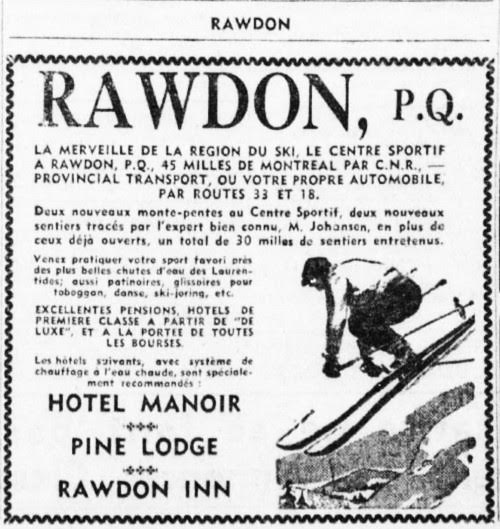
Advertisement published in La Presse, January 22, 1942 – Rawdon, P.Q.
Note the mention of Mr. Johansen. This is likely Herman Smith- Johannsen, known as Jack Rabbit, a cross-country skiing icon and well-known expert who is said to have laid out trails in Rawdon; he is the same person who is said to have laid out the trails at Mont-Tremblant.
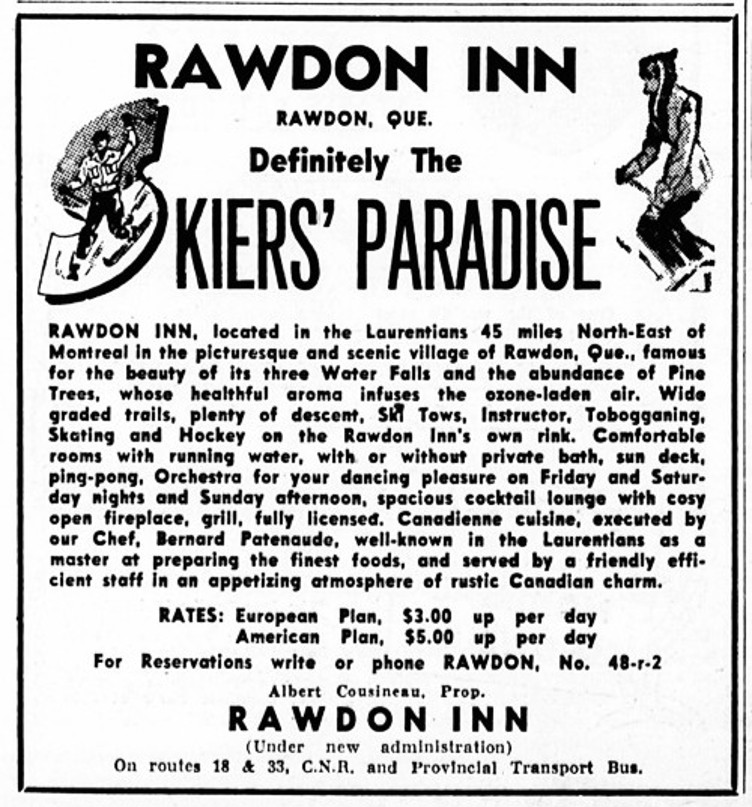
Advertisement published in the Westmount Examiner, March 4, 1949 – Rawdon Inn, Rawdon, Que.: Definitely The Skiers’ Paradise.
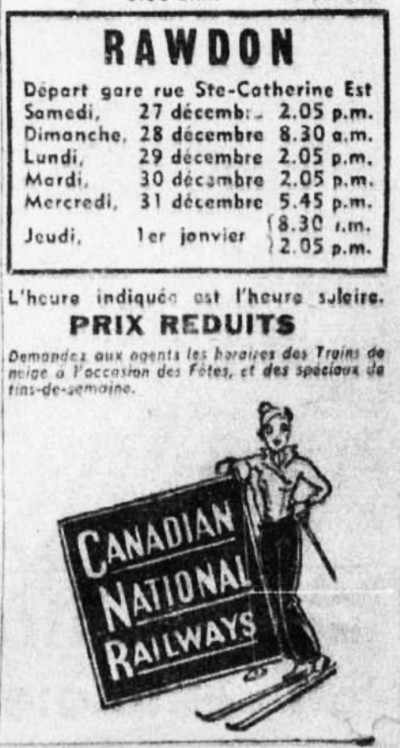
Advertisement published in La Presse, December 26, 1941, Rawdonpresenting the Rawdon train schedule.
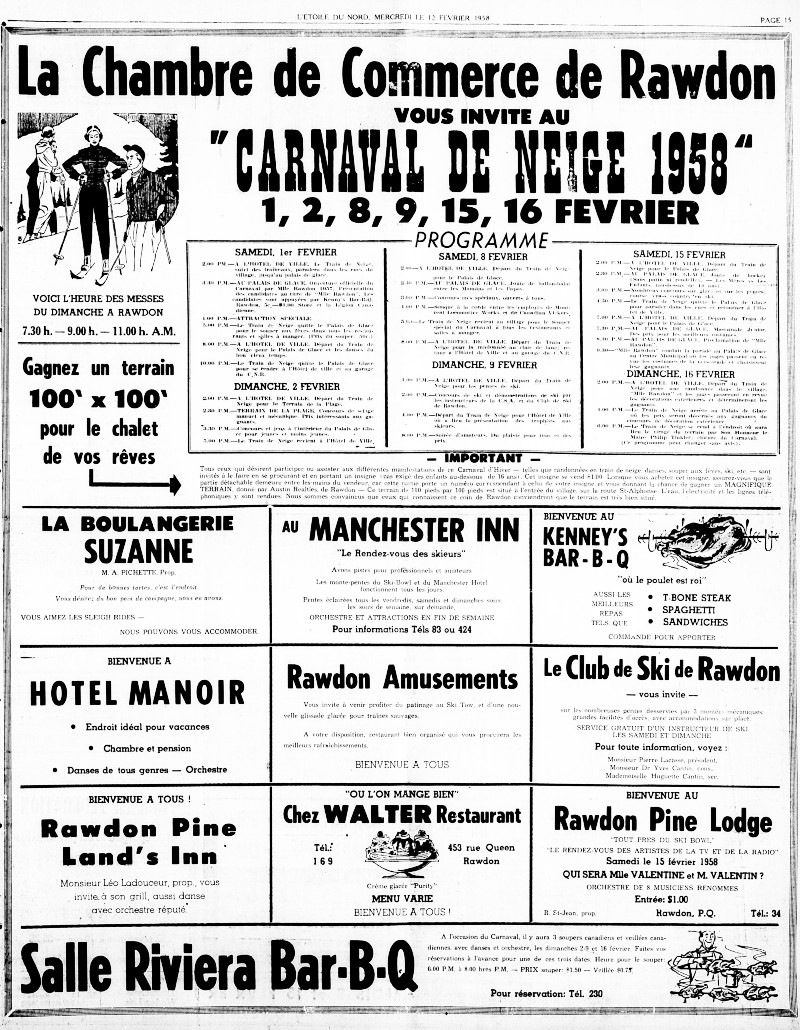
Advertisement published in L’Étoile du Nord, February 12, 1958.
The advertisement highlights the significant number of lodging facilities in Rawdon.
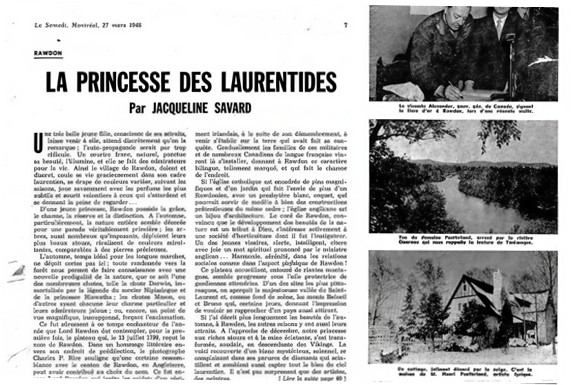
In 1948, in an article entitled “Rawdon, la princesse des Laurentides” (Rawdon, the princess of the Laurentians), published in Le Samedi, journalist Jacqueline Savard contributed to this promotion by also celebrating Rawdon’s attractions (4).
Article entitled “Rawdon, la princesse des Laurentides,” published in Le Samedi in 1948.
Transportation and recreational facilities
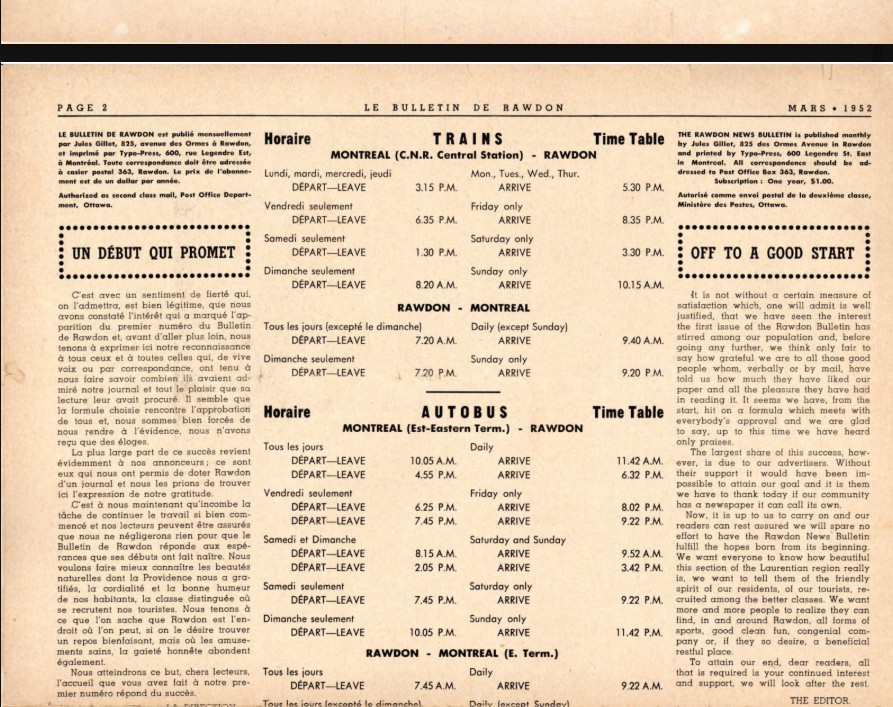
In the 1950s, Rawdon was served by several modes of transportation: cars, trains and buses. Rail service operated there from 1910 to 1957 (5).
Bulletin de Rawdon, March 1952
A 1952 issue of Le Bulletin de Rawdon also includes bus and train schedules.
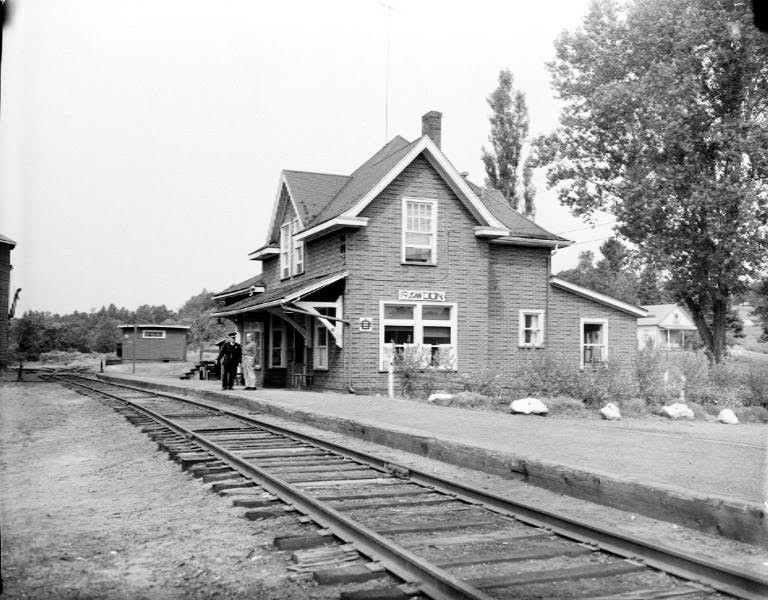
Photo: Fonds Ministère de la Culture et des Communications - Archives nationales in Montréal
The caption for this photograph of Rawdon station, taken from the Ministry of Culture and Communications Collection at the National Archives in Montreal, states: ‘The station housed the Canadian National Telegraph and Cable Office.’
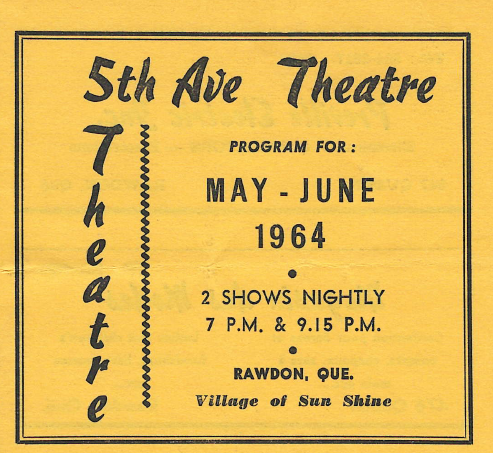
Among the entertainment venues was also a movie theater called the 5th Avenue Theatre, which was located on 5th Avenue east of Queen Street. The theater, which no longer exists, has been replaced by a parking lot.
At the eastern end of 5th Avenue, a path still leads to the lakefront today.
In the past, this path allowed residents to reach a pier that had been funded by the federal government in 1939 (6).
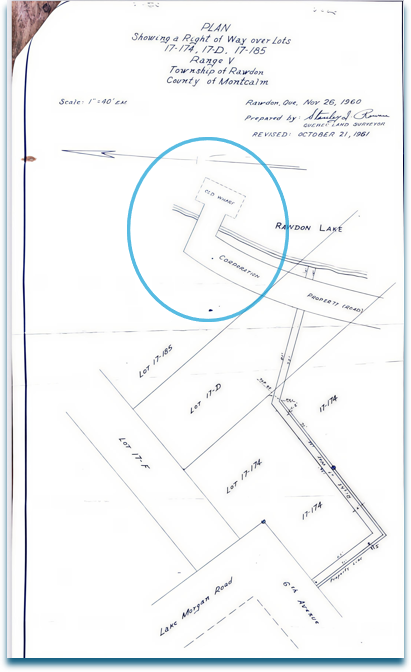
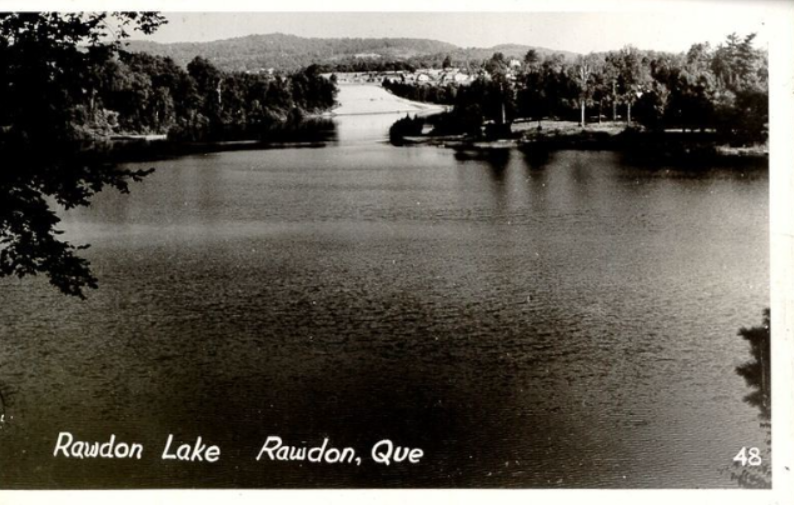
Although it no longer exists, this pier is identified on the 1961 survey map prepared by Rawdon surveyor Stanley Rowan as well as on an old postcard.
It was located in an area of the lake about 500 metres from the municipal beach, below the Catholic cemetery and the Jardin de la Roseraie.
Map drawn by Stanley Rowan, land surveyor, on October 21, 1961. Plan Showing Right of Way over Lots 17-174, 17-D, 17-185, Range V, Township of Rawdon, County of Montcalm
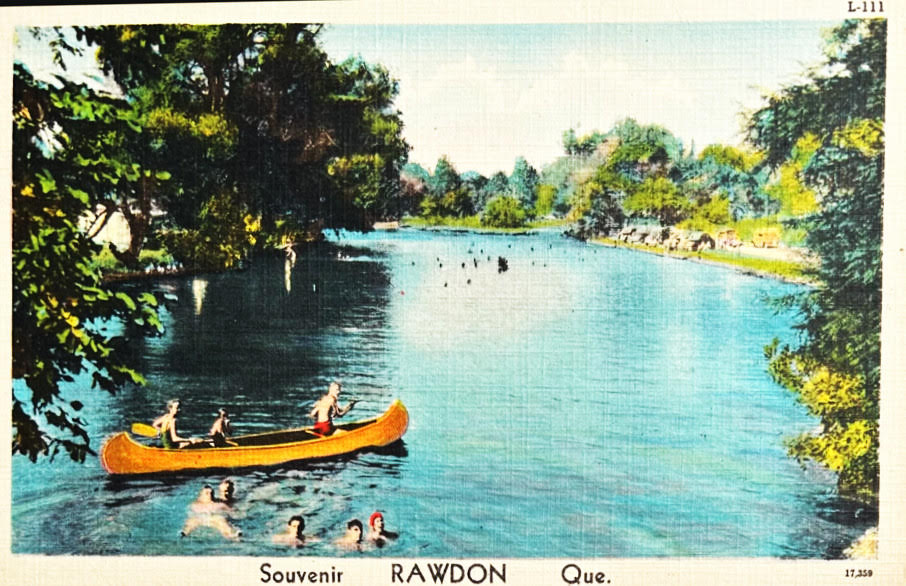
On this vintage postcard, the old pier is on the left side of the photo.
Rawdon Lake, Rawdon, Que., source: BAnQ
A landscape planned around 1910
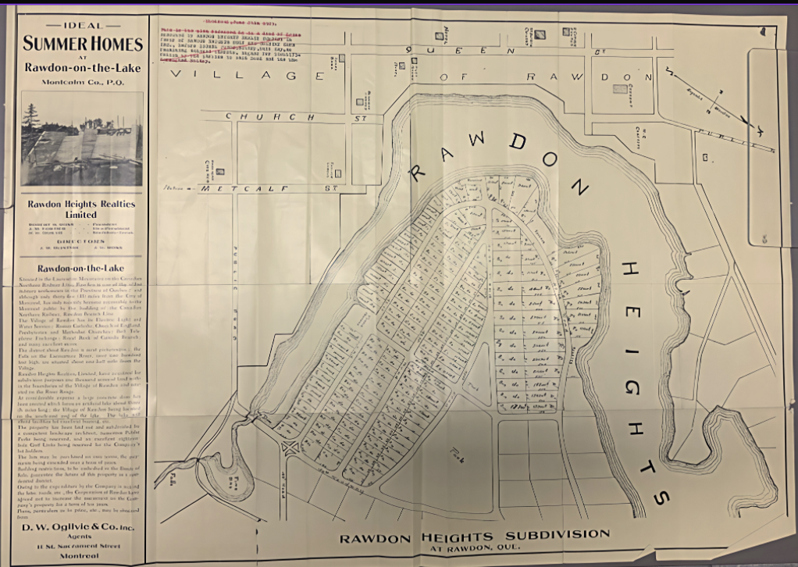
Front side of the landscape architect Rickson Outhet’s plan prepared for Rawdon Heights Realties Limited, Ideal Summer Homes by Rawdon-on-the-Lake, Montcalm County, PQ. Rawdon Heights Subdivision in Rawdon, Quebec (circa 1914–1915).
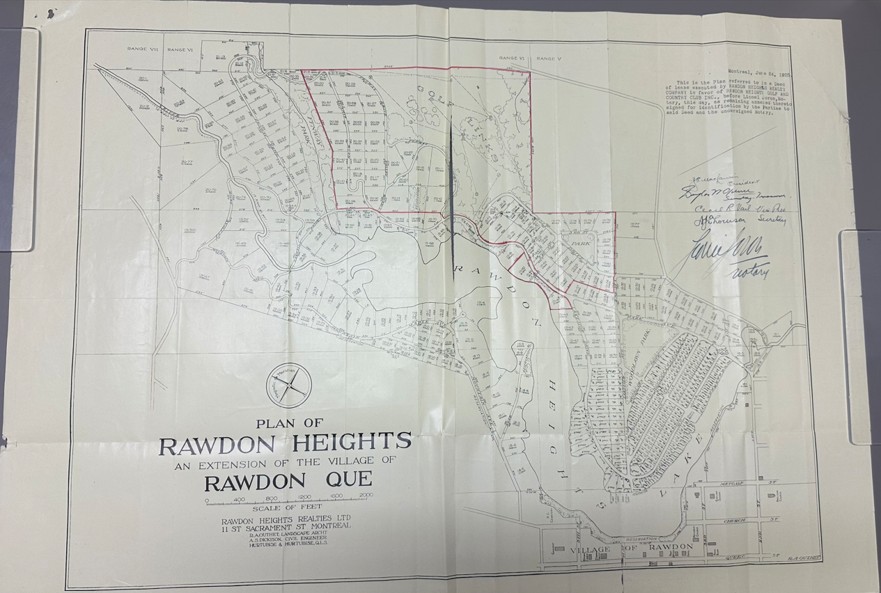
Around 1910, Montréal developers (7) began planning a large-scale resort project, as shown on this map. The design was entrusted to Rickson Outhet, a landscape architect associated with the City Beautifulmovement. Trained in the tradition of Frederick Law Olmsted, the father of landscape architecture, Outhet designed a development featuring a lake, several parks and green spaces and a golf course (8).
As the first landscape architect born in Canada, Rickson Outhet thus framed his work within an overall vision in which landscape, recreation and residential development came together to form a structured resort community.
Over the decades, many visitors purchased lakeside lots to build cottages there.
A legacy still visible today
Under the leadership of George Ainslie Finlayson, president of the Rawdon Land and Construction Company, the Rawdon Lake and Lakeshore Drive area began to develop with the opening of the road along the lake, the sale of lots and the creation of a golf course in 1926 (9). This project had a lasting impact on the resort landscape we still see today. Many of the original cottages and country homes have now become permanent residences.
Verso du plan de l’architecte paysagiste Rickson Outhet Plan of Rawdon Heights - An extension of the Village of Rawdon (circa 1914-1915).
Sources
Paquette, Marcel. Villégiature et tourisme au Québec, Tome 2 : 1911-1960 (Vacationing and tourism in Quebec, vol. 2: 1911–1960), Les Éditions GID, 2006, p. 24.
La Patrie. « Passez vos vacances dans les Laurentides! » (Spend your vacation in the Laurentians!), July 4, 1935, pp. 18–19. Website accessed on May 31, 2026. URL: https://collections.banq.qc.ca/ark:/52327/4324646